
Moorpark City Directory Collections
Moorpark does not have one continuous, itemized local shelf that covers every decade. The strongest city directory trail combines telephone books, a period Ventura County compilation, Library of Congress reels, catalog records, and county research holdings. Each source answers a different question, so the edition and keeper belong in every research note.
| Collection | Years | Where Held | Access |
|---|---|---|---|
| Pacific Bell Simi-Ventura Moorpark portions | Feb. 1990; Aug. 1990; Feb. 1991; Aug. 1992; Feb. 1993 | LA County Library Californiana inventory | Reference request; confirm branch and call number |
| Thousand Oaks YP/WP including Moorpark | 2001; 2002-03; 2003; 2004-05; 2005; 2006 | LA County Library Californiana inventory | Reference holdings; inspect the edition |
| City Directory of Ventura County | 1875 | Established genealogy-society digitization | Online scan; compare with an original when possible |
| Library of Congress telephone reels | Sep. 1947-Jul. 1953; Apr. 1958-Apr. 1961 | Library of Congress digital collection | Digitized reel scans and locality indexes |
| Ventura County directory catalog leads | 1941-42; 1948-49; 1962 | FamilySearch catalog | Inspect each cataloged volume before citing Moorpark |
| Moorpark Enterprise and county reference files | Dec. 30, 1915-Dec. 29, 1955; other dates by collection | Museum of Ventura County Research Library | Appointment-only reference research |
The regional books are telephone/address books, not annual Polk-style household directories. They do not prove that every household appeared, and a catalog entry does not guarantee that every Moorpark page survives. The 1875 compilation is a period source, not a current resident roll.
Moorpark City Directory Shelf Gap
A city-hosted 2022 environmental assessment records an attempt to find local street directories at Moorpark City Library, with no itemized local run available. That negative finding is useful. It keeps a researcher from assuming that a modern library catalog contains every older telephone or reverse directory.
The Moorpark City Library, at 699 Moorpark Ave., can still provide reference help and catalog guidance. Staff service is available Monday-Thursday 10 a.m.-8 p.m., Friday-Saturday 10 a.m.-5 p.m., and Sunday 1-5 p.m.; the phone is 805-517-6370. Ask for a specific year, publisher, locality, or microfilm lead rather than a vague request for “the Moorpark directory.”
The Moorpark City Library image and service details provide a practical starting point for confirming whether a requested volume is held or can be located through a regional loan.
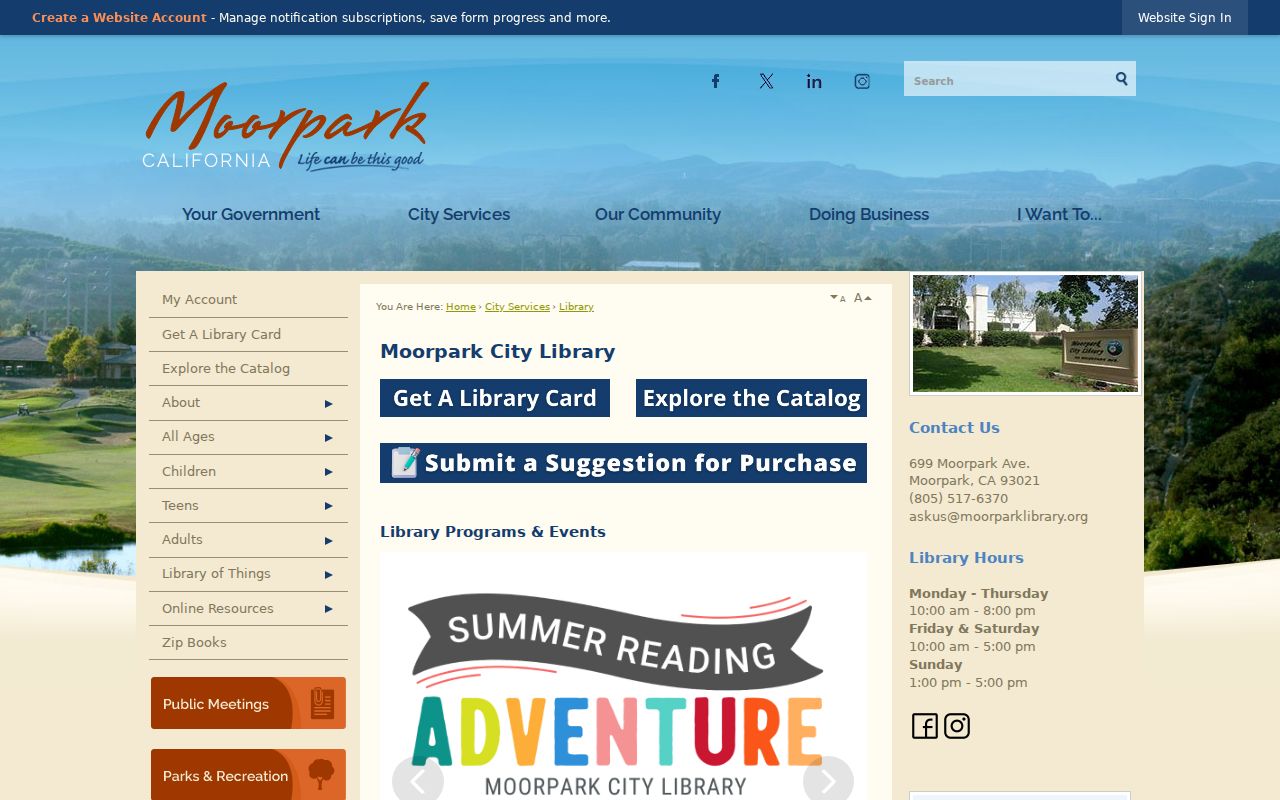
A catalog check can distinguish a true city directory from a general phone book and can reveal whether staff help, microfilm, or a referral is the available access route.
Moorpark Library service traces to 1912, and city governance records show the library leaving the Ventura County system in the 2007-era transition. The newer library project at 83 W. High Street has generated environmental, funding, and planning records that can preserve prior-use descriptions and agency correspondence even when a directory volume is absent.
The Moorpark Public Records Archive is a separate city-created source for ordinances, resolutions, minutes, staff reports, and board records. Names found there identify an applicant, speaker, official, or consultant in context; they do not convert a city file into a resident directory entry.
Pacific Bell Moorpark Directory Runs
The LA County Library Californiana inventory identifies Moorpark portions in Pacific Bell’s Simi-Ventura address and phone directory for February 1990, August 1990, February 1991, August 1992, and February 1993. The gaps between issues are part of the evidence. A person present in February 1990 but absent in August 1990 may have been unlisted, missed by an edition, or represented by a spelling variant.
The same inventory lists Thousand Oaks YP/WP editions for 2001, 2002-03, 2003, 2004-05, 2005, and 2006. Search the exact book rather than calling the whole run a yearly series. A yellow-pages or white-pages volume may separate business and household entries, and the presence of a Moorpark portion does not guarantee an address-keyed reverse section.
The Californiana directory inventory is the best citation for the listed later runs. No openly digitized page from those Pacific Bell editions was located, so a reference request is needed for a named sample entry or abbreviation key.
The Library of Congress reels give an older bridge: Moorpark appears from September 1947 through July 1953 and again from April 1958 through April 1961. The 1947 issue names Santa Paula Home Telephone Company; later publishers need inspection. A verified older entry uses a compact name or initial, an optional Mrs or business marker, r for residence, a compressed road or locality, and an exchange or telephone number.
Moorpark Historical Research Desks
The Museum of Ventura County Research Library is the county-level fallback for directories, census records, voter indexes, newspapers, maps, manuscripts, assessor material, and family files. It is free and appointment-only Wednesday-Friday, 11 a.m.-5 p.m., at 100 E. Main St., Ventura. Contact 805-653-0323 ext. 320 or library@venturamuseum.org. Ask for Moorpark telephone books, tract maps, voter registers, school annuals, newspapers, or surname files by exact year.
Its holdings include the Moorpark Enterprise from December 30, 1915 through December 29, 1955. Those four decades can supply obituaries, legal notices, addresses, school reports, advertisements, and community names when a directory year is missing. A newspaper mention is a lead, not automatic proof of residence.
The Moorpark Historical Society, founded in 1979, adds photographs, stories, tours, and preservation contacts. Recent city material reports a $5,000 California State Library grant for the City Librarian to digitize and archive remaining Society materials, creating a future source for names and places that are not in a phone book.
The Ventura County Genealogical Society maintains a research library at Camarillo Public Library and offers regional database guidance. Its resource notes point researchers toward library subscriptions, census material, local-history books, probate, tax lists, and directory collections when a named Moorpark volume is held off-site.
The Moorpark Historical Society image points to the local organization behind that preservation work, while the grant makes it sensible to recheck the library and Society for newly accessible material.
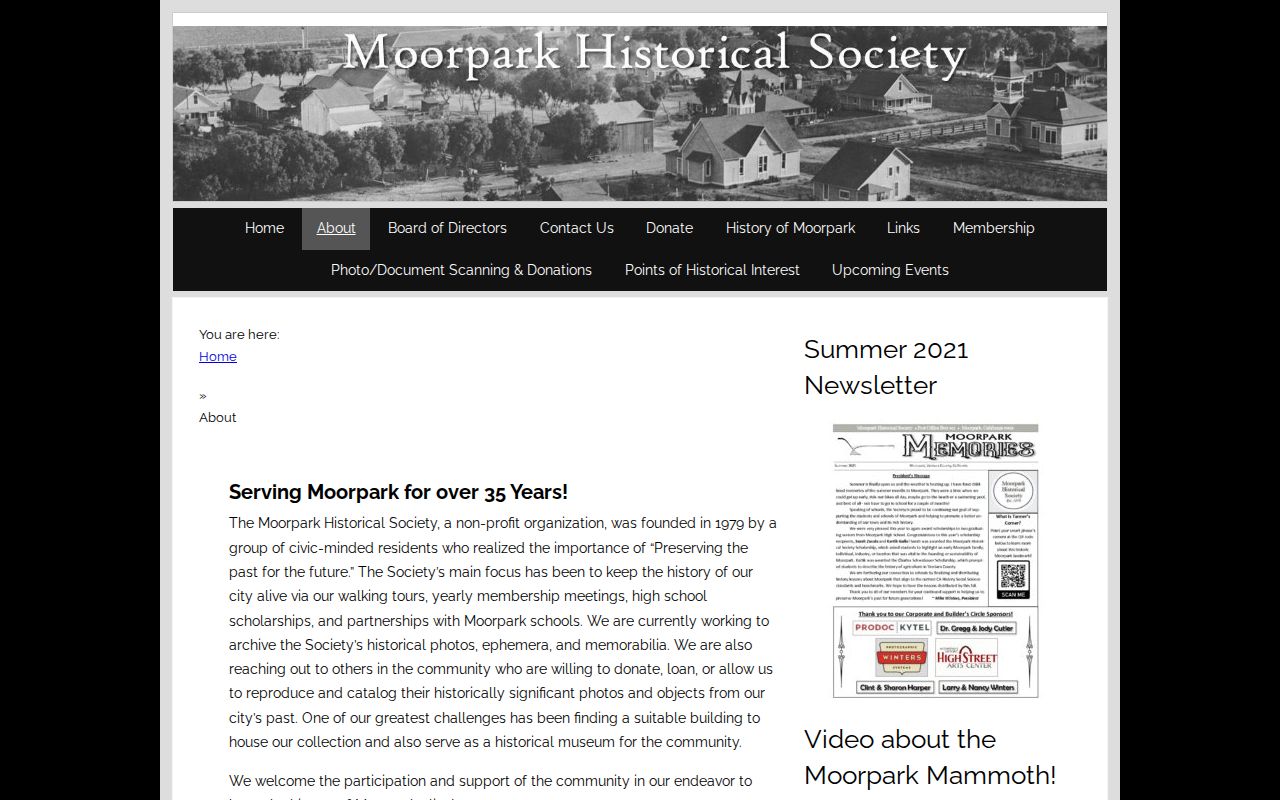
Use the Society for local leads, then confirm dates and identities in a directory, newspaper, deed, census, or vital record held by the appropriate custodian.
Read a Moorpark City Directory Entry
A telephone entry is narrower than a traditional city-directory entry. The usual white-pages pattern is surname, given name or initials, street address, and telephone number. A business entry adds a business name, category, address, and phone. Traditional volumes may add a spouse in parentheses, an occupation, a widow notation, or a home and business address, but those fields cannot be assumed in the Pacific Bell runs without inspecting the publisher’s key.
| Name | Surname with given name or initials; preserve compound surnames, hyphens, and spelling variants. |
|---|---|
| Address | House number and street, or a compressed road/locality line in the older reels. |
| Telephone | Exchange and number where listed; a number is not proof that every household member lived there. |
| Spouse or occupation | Possible in traditional directories, but inspect the specific volume before treating it as a field. |
| Owner or renter mark | Possible in some householder formats; a symbol must be read from that edition’s legend. |
- Criss-cross directory
- An address-order or street-order list used to move from a place to a listed name. Confirm that the volume actually contains that section.
- Householder index
- A name-to-address index centered on a household head or listed subscriber, not a complete roster of everyone at the address.
- Abbreviation key
- The publisher’s legend for short forms such as r for residence in a verified older phone entry. Photograph or transcribe it before reading marks.
Moorpark’s 1873 Records Turning Point
Ventura County was formed from Santa Barbara County in 1873. For a pre-1873 Moorpark lead, search Santa Barbara County, mission-era material, and state land records before treating a missing Ventura entry as an error. Moorpark was incorporated in 1983, so earlier local names are more likely to appear in county, precinct, newspaper, school, church, and agricultural records than in a city-government series.
| Period | Research marker |
|---|---|
| 1873 | Ventura County forms; earlier county trails point to Santa Barbara County. |
| 1912-1955 | Moorpark library service and the Moorpark Enterprise create local reference and newspaper trails. |
| 1979-1983 | Historical Society founded; Moorpark later incorporates as a city. |
| 2025-2026 | State-library digitization grant supports preservation of remaining Society material. |
Trace Moorpark City Directories With Census
Directory tracing works best as a dated comparison, not a single-name search. A Moorpark city directory supplies a listed-name clue, while the census supplies a household snapshot at a different date. Federal population schedules are public through 1950, while the 1960 schedules are expected in 2032. Individual 1990 schedules remain closed, so the 1990-93 directory gap must be bridged with deeds, assessment material, newspapers, or other lawful sources.
- Choose a person or address, preserve the exact spelling, and write down the edition date and page or reel reference.
- Check every available directory edition, recording first appearance, last appearance, address changes, initials, phone changes, and any stated family clue.
- Pair a directory date with the nearest open census schedule. For pre-incorporation research, use the Ventura County township, precinct, or enumeration district rather than modern city limits.
- Use deeds, assessment rolls, permits, newspapers, obituaries, or probate to test a move, death, ownership change, or building event between editions.
- Close the trail with a second source. A first or last appearance can reflect an unlisted number, publication lag, boundary coverage, OCR error, or a name variant.
A missing name is therefore a research result, not a conclusion. The best notes state which repositories and editions were checked, which were unavailable, and which fact still needs confirmation from the holding institution.
Moorpark Directory Absence and OCR
No official recorder cutoff, complete local shelf list, or openly digitized page for every identified run was located. FamilySearch catalogs the 1941-42, 1948-49, and 1962 Ventura County directory leads, but each volume must be inspected before citing a Moorpark entry. The Library of Congress reels and the later regional books fill different eras, not one seamless series.
When an image is hard to read, compare the scan with the locality index, try surname variants, and ask the library or archive to verify the page. A citation to the keeper, year, locality, and entry type makes a historical Moorpark city directory find reproducible without overstating what the record proves.